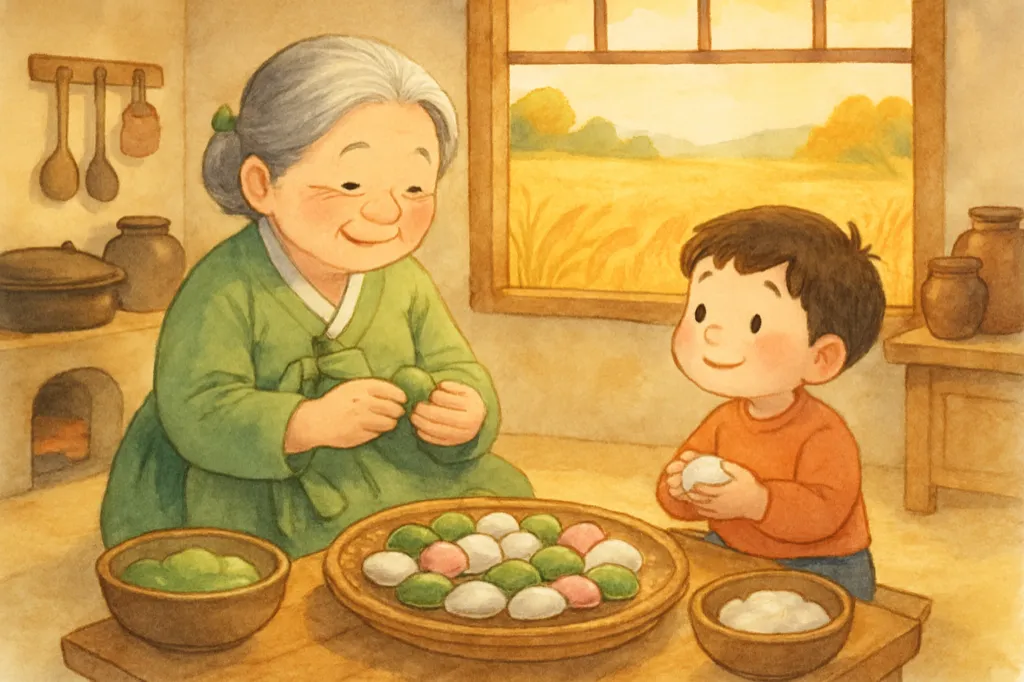
Minjun was nine years old, and he wanted to stay home in Seoul for Chuseok. He had a new game he hadn’t played yet. His friends had planned a trip to the movies.
But his father said that every year they went to Grandmother’s house in the small village in the south. No exceptions.
Minjun got into the car with a very set expression on his face.
His grandmother’s village was quieter and slower than Seoul. Trees all around, cool air, the smell of rain on earth, and the scent of cooking already drifting from the kitchen even at dawn.
Grandmother Pak waited at the gate, white hair curled neatly, wearing a pale green hanbok.
“Minjun!” She hugged him tight.
He hugged back, still sulking a little.
“Come help me make songpyeon,” she said.
“What’s songpyeon?”
Her eyes went wide. “You don’t know songpyeon? The Chuseok rice cake!” She took his hand and led him to the kitchen.
The kitchen was full of people and activity. A large mound of kneaded rice flour sat on the table, along with sweet bean filling, pine needles, and the hands of aunts, uncles, parents — all sitting in a circle, working together.
“How do you make songpyeon?” Minjun asked.
His grandmother sat and picked up a piece of dough. “Press it flat first, put filling in the center, then fold it into a half-moon shape. The half-moon means we hope for a full, complete life — like a full moon.”
Minjun tried. His first one came out lopsided. Everyone laughed, but not unkindly. His grandmother held his hands and guided them. The second was better. The third almost right.
“What’s Chuseok really about?” Minjun asked, kneading dough.
His father answered. “It’s a day of thanksgiving for a good harvest. Our ancestors planted rice, and when the harvest season came, everyone returned home to gather, to thank nature, and to honor those who worked before them.”
“But we don’t farm rice anymore.”
“It’s not just about rice,” his grandmother said. “Chuseok teaches that everything we have today came from people who worked before us — parents, grandparents, ancestors. Coming back here is how we thank them.”
After breakfast, the family performed charye — placing food on the table and bowing in respect to their ancestors. Minjun had never done it before. He stood watching his father bow slowly and carefully, feeling something strange and serious stir inside him.
“Who are we bowing to?” he asked quietly.
“The people who made today possible,” his father said.
Minjun stood still for a moment. Then slowly lowered himself into a bow. He wasn’t sure if he was doing it right. But it felt heavier and more real than he’d expected.
In the afternoon, his grandmother took him to sit on the wooden veranda in front of the house. The rice paddies beyond stretched golden and full in every direction.
“You like Seoul a lot, don’t you?” she asked.
“I do, but…” Minjun paused. “Today wasn’t bad at all, Grandmother.”
“Not bad?” She laughed. “That’s good enough.”
“Was my songpyeon good?”
“The best at the table.” She said it even though Minjun was pretty sure it wasn’t true.
But it sounded good anyway.
On the drive back, Minjun sat looking out the window. The golden rice paddies caught the evening light and glowed.
Next year, he thought, he’d come back. And this time, he might not need to be told.
A lesson from the festival: Korea’s Chuseok teaches that returning to our roots and honoring those who came before us is part of knowing who we are. Progress and technology are good things — but memory and family are things that can’t be bought.