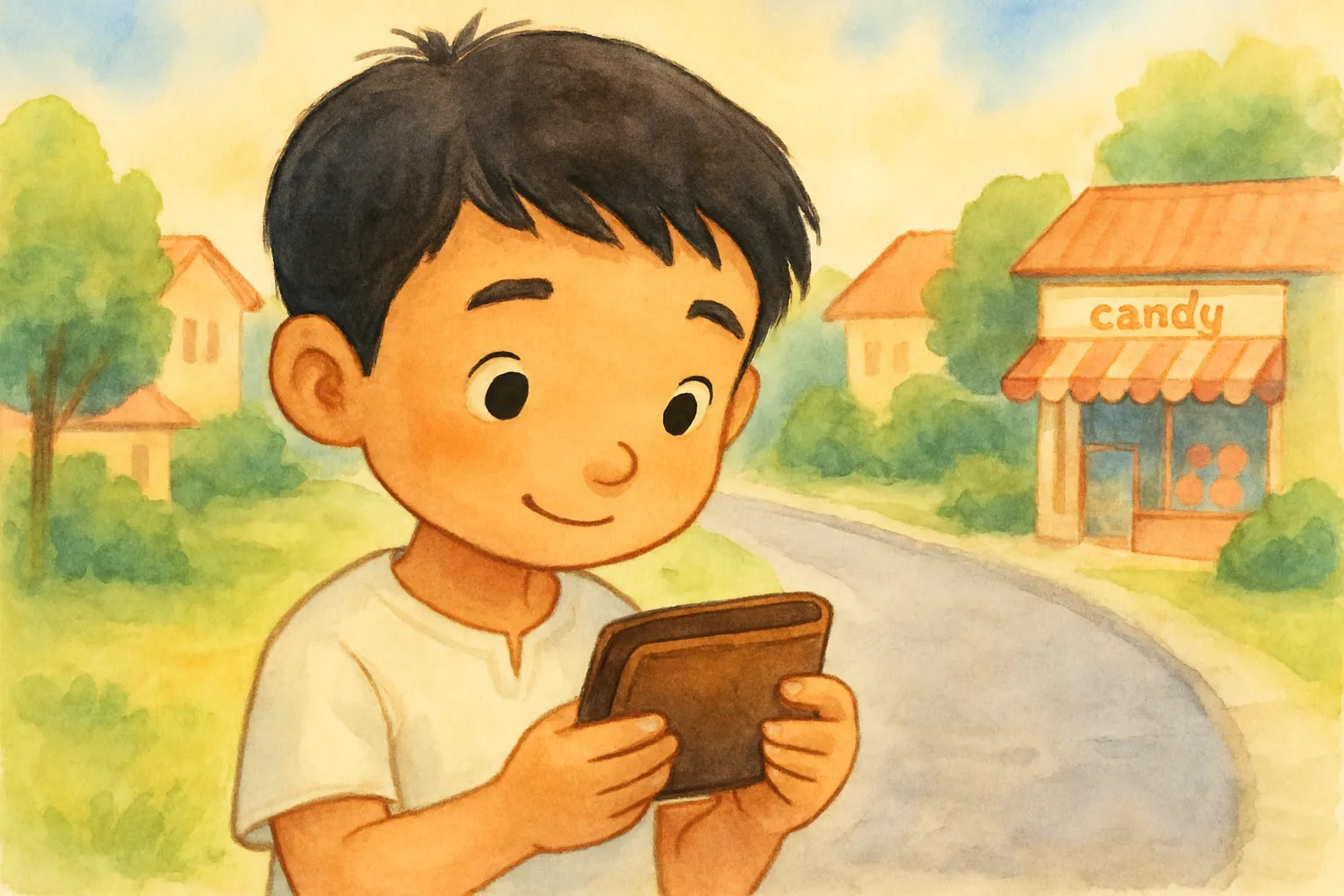
Pae was an eight-year-old boy who had wanted a big chocolate bar from the shop near his school for a long time. But his mother said money was tight this month, so he’d have to wait.
On Wednesday after school, Pae walked home along his usual path, kicking a small pebble along the way, when he saw it.
A small brown wallet lying by the fence.
Pae picked it up and opened it. Inside was a folded 200-baht bill and an elderly man’s ID card.
Two hundred baht, Pae thought immediately. That’s enough for several chocolate bars.
He stood still in the middle of the path, looking at the wallet in his hand, then glancing toward the sweet shop he could see at the end of the street.
Part of him thought, the owner dropped it themselves — anyone could pick it up.
But another part of him looked at the ID card. The name read Somchai Wongthong, age seventy-two, address right on this very street.
Pae turned the wallet over in his hands twice, remembering something his mother had once told him: things that aren’t ours — even if no one else knows, we know.
So he walked straight to the house listed on the card.
It was a small house with a jasmine plant by the door. Pae knocked on the old wooden door. After a moment, slow footsteps approached, and the door opened.
A small, elderly man looked at Pae with a puzzled expression.
“I found your wallet, sir,” Pae said, holding it out.
The old man’s eyes widened. He took the wallet with slightly trembling hands, opened it, and smiled.
“Oh my,” he said softly. “I’ve been searching since this morning. My medicine money was in there too.”
Pae felt something warm rise in his chest — not just pride, but as if some weight had lifted off him.
“Wait a moment,” Grandfather Somchai disappeared into the house and came back out with a small bag of snacks. “Here, take this. Thank you so much.”
Pae looked at the snacks in his hand and shook his head gently. “It’s okay, sir. I just did the right thing, that’s enough.”
But Grandfather Somchai held them out again. “Please, take them. I really want you to have them — not just as thanks, but because a child like you reminds me that goodness still exists in this world.”
Pae accepted the snacks and walked home with a light heart.
The snacks weren’t the big chocolate bar he had wanted for so long, but they tasted better than anything he had ever eaten, because he had earned them by doing what was right.
That night, Pae told his mother everything. She listened quietly until the end, then hugged him tight, not saying a word for several long seconds.
“My son has really grown up,” she said softly.
Pae didn’t know what to say, so he just smiled and buried his face in her chest.
The next day, on his way to school, Pae walked past the sweet shop and looked at the big chocolate bar in the glass case. Then he kept walking, without feeling nearly as much regret as he expected.
Because what he had gained yesterday had no price tag any sweet shop could offer.
From that day on, whenever Pae faced a difficult choice, he would always ask himself: if I did this and told my mother about it, would my heart feel light or heavy?
That question always led him to the right choice.
Moral: Honesty doesn’t always reward us right away, but it gives us something money can never buy — the feeling of knowing we are a good person. And that feeling stays with us far longer than any sweet ever could.