Once upon a time, a boy named Phu’s father told him bedtime stories about the great stone temple in Cambodia — a colossal structure built a thousand years ago with no machines at all, only human hands and determination.
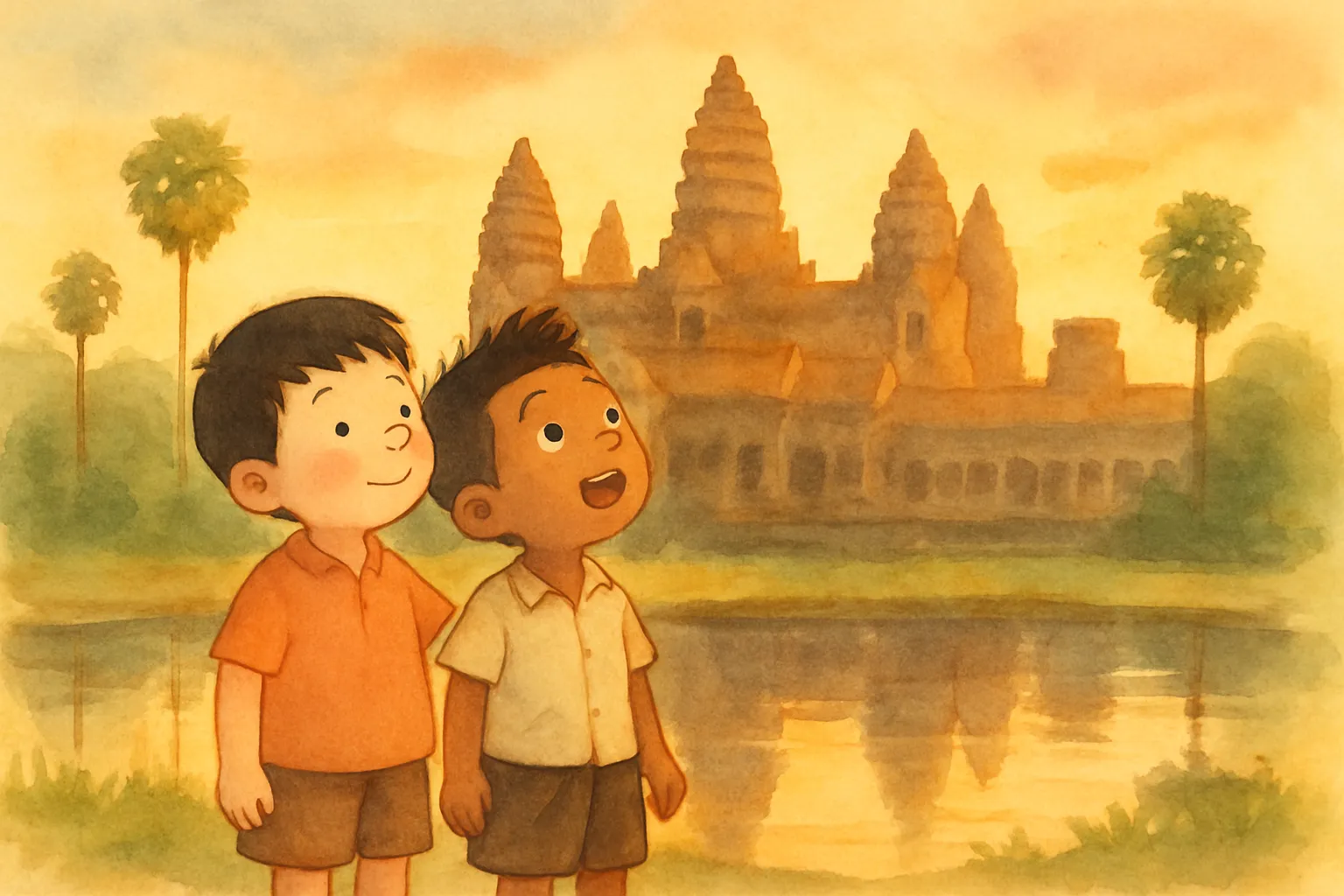
When Phu finally visited in person, he stood before Angkor Wat with his mouth hanging open.
The grey-pink stone temple rose majestically from the middle of a great pool, its five spires reflected in the still water. Enormous trees grew all around, as if nature itself were embracing the temple.
While exploring inside, Phu wandered away from his group and got lost in the old stone corridors.
A Khmer boy about his own age walked up to him. “Nak bat baan te?” he asked.
Phu shook his head. “I’m lost.”
The boy smiled and tried some English. “Come, I show you.”
His name was Dara. He had lived near Angkor Wat his whole life and knew every corner of it. Dara led Phu down a long stone gallery covered in carvings.
“What’s this?” Phu asked, pointing to a carving showing thousands of figures pulling something together.
“This is the Churning of the Sea of Milk,” Dara explained. “Gods and demons worked together to create the elixir of immortality. Even though they were enemies, some things had to be done side by side.”
Phu studied the carving for a long time, remembering what his father had told him — that this temple had been built by hundreds of thousands of people working as one.
“How long did it take to build this place?” Phu asked.
“Thirty years,” Dara answered. “And it’s still standing a thousand years later.”
Before they parted ways, Dara picked up a small, smooth stone and handed it to Phu. “A stone from Angkor Wat. Remember — great things are built by many hands working together.”
Phu carried the stone back to Thailand and placed it on his desk.
And every time he felt like he couldn’t do something alone, he would pick up that stone and think of the hundreds of thousands of people who once lifted something far heavier, together.
Fun facts about Cambodia: Angkor Wat was built in the 12th century by King Suryavarman II and is the largest religious monument in the world. Today it is a UNESCO World Heritage Site and appears on Cambodia’s national flag.