In a small village at the foot of a mountain, a boy named Nuanjai lived with his mother in an old wooden house. The roof leaked when it rained, and in the afternoon sun you could see light coming through gaps in the walls.
The family didn’t have much. A small rice field, three or four hens that laid an egg or two each day, and a mother who wove cloth to sell at the Thursday market. After school, Nuanjai helped tend the field.
But though they were poor, Nuanjai never felt he was missing happiness - because his mother always told him: “Happiness doesn’t come from what you have. It comes from who you are.”
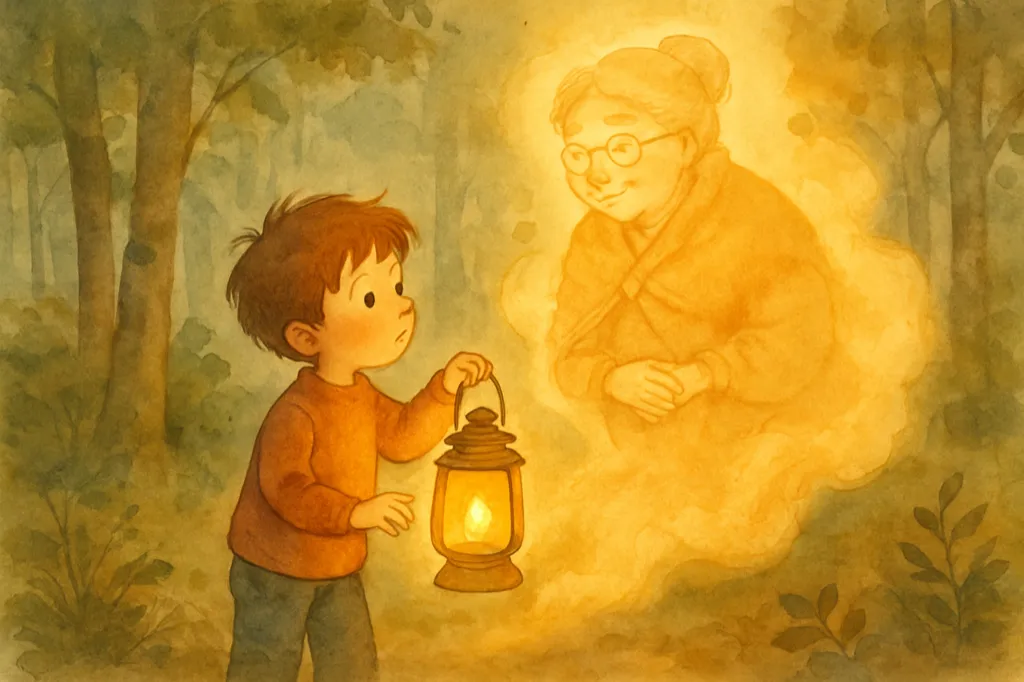
One day during the harvest season, Nuanjai went into the forest to gather firewood. Reaching down for a branch, his hand touched something hard and cold. He looked down and found an old metal lantern half-buried under rotting leaves.
It looked ordinary at first - old and dirty, with strange carvings running around the outside. Nuanjai wiped it with the hem of his shirt. And in that instant, a golden light burst from the lantern’s mouth.
Golden smoke curled upward, slowly taking the shape of a small old woman with hair as white as snow, wearing silk robes the color of gold. She smiled warmly.
“Little one, you have woken me,” the old woman said, her voice like flowing water. “I am the Lantern’s Guardian. Whoever wakes me receives three wishes. Ask for anything.”
Nuanjai’s eyes went wide. His heart hammered. He stood for a long moment.
“May I have some time to think?” he asked.
The old woman smiled. “I’ll wait at your home.”
Nuanjai ran back and told his mother everything. His mother listened calmly - less excited than he’d expected.
“Aren’t you happy, Mother?” he asked.
“Of course,” she said. “But I want you to think carefully first. Three wishes are precious. Don’t waste them.”
“I’ll ask for a new house, a full grain store, and then…” Nuanjai paused. “Is there anything you want, Mother?”
His mother took his hands in hers. “I’ve been ill for many years, and you know it. If I were well again, I could weave more cloth. Our life would be better.”
Nuanjai nodded. Then he walked to where the old woman waited in the corner of the room.
“I have three wishes,” he said steadily. “First: please let my mother be completely well. Second: please let us have enough rice for the whole year. And third…”
He paused again. In his mind he saw a new house, new clothes, all the things he’d ever wanted. But then he thought of the house next door, where old Auntie Kham and Uncle Bua lived alone without children to look after them, sometimes going without rice.
“Third: please let every household in this village have enough rice for the whole year too.”
The old woman nodded, her eyes shining. “As you wish.”
Golden light burst from the lantern once more, and then everything was still.
The next morning, his mother sat at the table eating rice porridge with a brightness in her face that Nuanjai hadn’t seen in years.
“I feel so much better,” she said, surprised. “I slept so soundly last night.”
The grain store that had been nearly empty was full of clean white rice. And when Nuanjai walked through the village, he heard the neighbors all talking about the same thing - every house had found more rice than they’d had before, for no reason anyone could explain.
“Who could have done this?” Auntie Kham asked her neighbor, her voice trembling with joy.
Nuanjai smiled quietly and told no one.
That evening, he sat by the rice field with his mother, watching the sun sink below the hills. In his hands was a sticky rice cake his mother had made.
“You didn’t ask for a new house or anything for yourself,” his mother said softly.
“No,” Nuanjai answered. “This house has you in it. That’s enough.”
His mother said nothing. She just put her arm around her son.
And that was the night Nuanjai felt richer than he ever had - not because the grain store was full, but because what he had chosen had made the people he loved happy.
The old lantern sat on a shelf in the house, its light never returning. But Nuanjai never forgot what it had taught him.
Moral: Lasting happiness doesn’t come from what we receive. It comes from what we choose to give. When we take care of those around us, that happiness returns to us in ways we never expect.